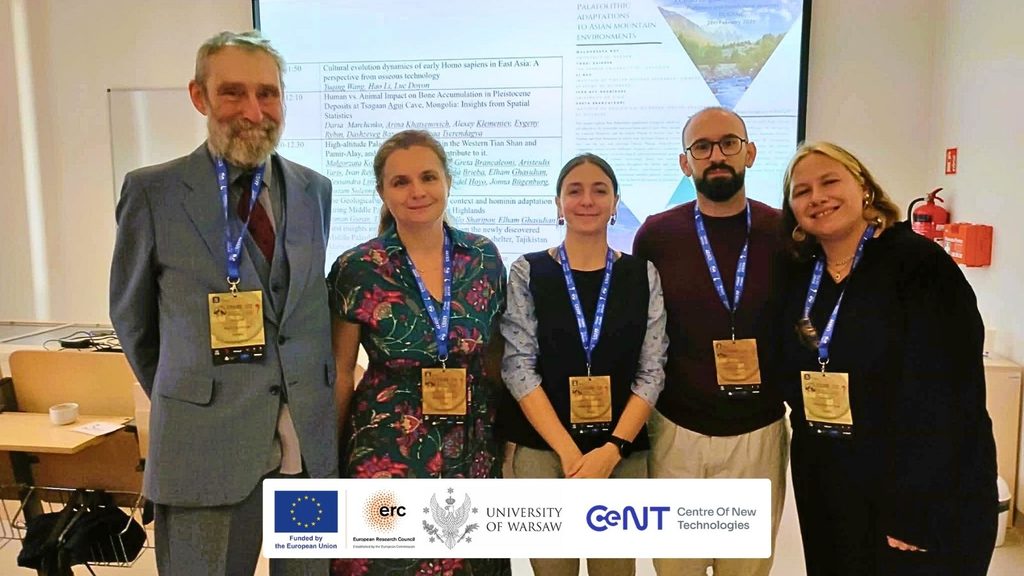
The INASIA team, led by our PI Prof. Małgorzata Kot, took part in the 21st World Congress of the International Union of Prehistoric and Protohistoric Sciences (UISPP), held in Poznań from 31 August to 4 September 2026. As part of the Congress, Prof. Małgorzata Kot co-organized the session S13C – “Lost in translation: How differences in terminology shape our view of cultural evolution in the Paleolithic of Eurasia,” together with Peiqi Zhang, Masami Izuho and Nicolas Zwyns.
The session focused on a fundamental challenge in Palaeolithic archaeology: how the terminology we use affects the way we describe and interpret the archaeological record. Researchers working in different regions and academic traditions may use the same terms, such as “blade”, “Levallois” or “Initial Upper Palaeolithic” in different ways, or use different terms for similar technologies and archaeological phenomena.
These differences are particularly important when comparing evidence across the vast geographical scale of Eurasia. The session raised a key question: do the patterns we observe in the archaeological record reflect actual differences in past human behaviour, or can some of them result from differences in terminology, classification systems and research traditions? By bringing together researchers working in different regions of Eurasia, the session aimed to identify where information may become “lost in translation”, distinguish problems of technical language from genuine archaeological variability, and foster clearer communication and more meaningful comparisons between regional records.