
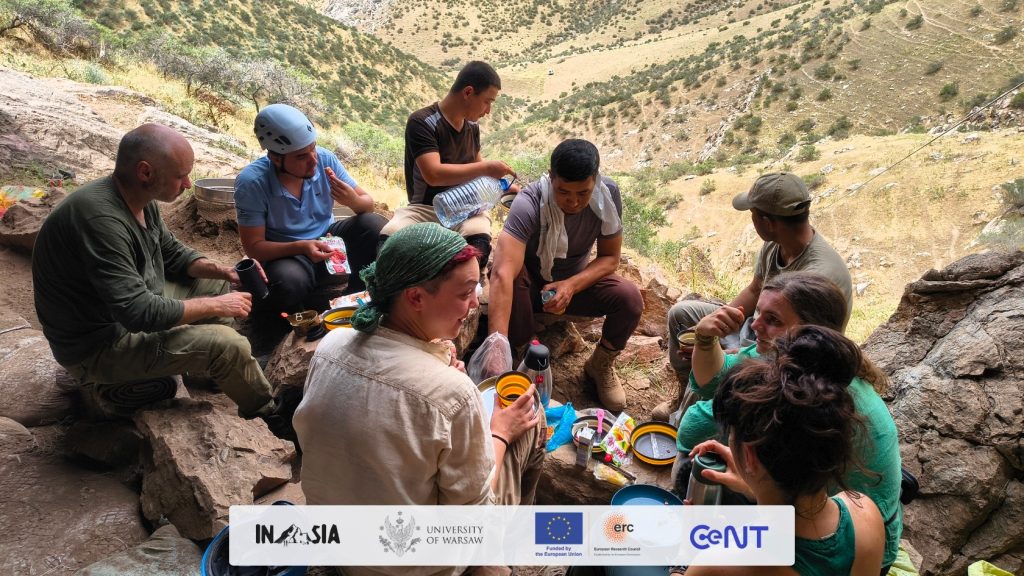
Fieldwork is often imagined as excavation, documentation and discoveries. But before any of this can happen, there is another part of archaeology that is just as important: setting up a safe base, adapting to local conditions and learning how to work with the landscape.
The INASIA team has now arrived in Kashkadarya, southern Uzbekistan, where our fieldwork is taking place. This is the region of Kiik Kamar Cave, one of the key sites for our project on the Initial Upper Palaeolithic in Central Asia. The landscape is beautiful, but it is also demanding. Working here means dealing with mountains, sudden weather changes, high grass, wildlife and the practical challenges of daily life in the field.

Our base is located in a village near the site. This season, the team had to change the exact location of the base, although we remain in the same village. The new place is more exposed to wind, so even in warm weather, a blouse or wind jacket can be useful.
The basecamp is set up in the garden of a local family’s house. We sleep in tents, use the summer kitchen, bathroom and toilet, and one room has been adapted as a small field laboratory. The area is closed with a gate and provides a safe working and living space for the team.
Living in the village also means being close to local everyday life. Chickens, a cow, a traditional family household and a very friendly daughter of the house, who is an English teacher, are all part of the atmosphere of the base. We are guests here, so we also adapt to local customs and dress respectfully, especially by wearing long sleeves in shared spaces.

Food is prepared by a local Uzbek cook, together with her daughter. This gives the team a chance to eat traditional Uzbek cuisine every day. Breakfast, lunch and dinner are cooked at the base; lunch and dinner are usually hot meals. On cave days, when the team is working away from the base, lunch is taken to the site as a packed meal.
For people with specific dietary needs, such as vegan or gluten-free diets, fieldwork requires extra planning. It is useful to bring some dry or prepared food, just in case. The nearest good shop is about 40 km from the village, and the nearest supermarket is around two hours away by car, so everyday logistics matter as much as excavation strategy.
Water is another essential part of life at the base. Each team member is asked to bring a personal cup and a water container. At the base, we use a LifeStraw water filter system, which allows us to filter water and make it drinkable. In remote field conditions, simple systems like this are crucial. They help the team remain independent, safe and ready for long working days.
This year, spring in Uzbekistan has been unusually wet. The landscape is full of flowers and very high grass. It is beautiful, but it also changes the way we work. Wet weather can mean mud, difficult tracks and occasional flooding. Raincoats are useful, and every movement around the site has to be planned with the weather in mind.
The weather also shapes the rhythm of the day. At the basecamp, temperatures can be very high during the day, reaching up to 45°C, so the team has to be prepared for heat, sun and dehydration. The cave, however, offers very different working conditions. Inside Kiik Kamar, the temperature is much more comfortable, around 20–25°C, and the team works in the shade. In this sense, the cave is not only the focus of our research, but also one of the few cooler places in the landscape.

The wet spring has also brought more wildlife activity. There are many snakes in the area, and at least three have been seen in the cave. This is not unusual: we are working in a natural environment, and the cave is part of a living landscape. For safety, team members wear long shoes, especially during survey work, and gloves are obligatory during fieldwork. Walking sticks are also useful, not to harm the snakes, but to make vibrations while walking through high grass and give animals time to move away. The aim is simple: to protect both people and wildlife.
There are no mosquitoes in this part of Uzbekistan, but there are bees and hornets. Tents need to be closed carefully, especially the zips, and breathable tents are recommended because the nights are warm. Temperatures at night are expected to stay above 25°C, so a light sleeping bag is enough. A good mattress, however, is essential. Fieldwork is exciting, but taking care of your body is part of doing good science.
Fieldwork in Kashkadarya is therefore a combination of science, logistics and adaptation. The team works between the cave and the village, between laboratory work and daily life, between careful archaeological excavation and the realities of mountains, weather, animals and local hospitality.
The INASIA project has received funding from the European Research Council under the European Union’s Horizon Europe research and innovation programme, grant agreement No. 101168587.
Views and opinions expressed are however those of the author(s) only and do not necessarily reflect those of the European Union or the European Research Council Executive Agency. Neither the European Union nor the granting authority can be held responsible for them.